Selective catalytic reduction
NOx and O2 level measurements
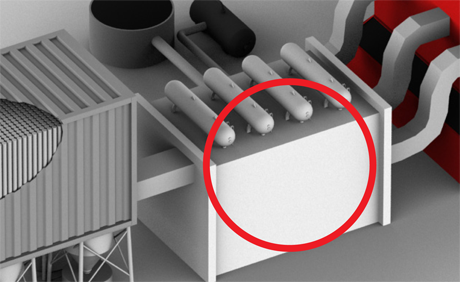
In a coal-fired power plant, selective catalytic reduction (CRS) is used to convert nitrogen oxides with the aid of a catalyst into diatomic nitrogen and water (aqueous ammonia), reducing nitrogen oxide (NOx) emissions.
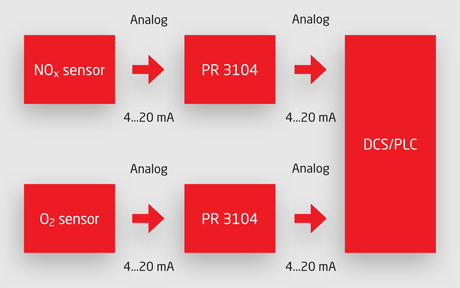
In order to maintain a reliable process, NOx and O2 levels must be stable. Sensors measuring both the NOx and O2 level in a high temperature environment are necessary and must provide a stable, high accuracy signal to the DCS. With a 7 ms response time, an accuracy of +/-0.05% and 2.5 KV isolation, the 3104 isolated converter is a great solution for this application.
Application:
> Need more information? Please contact us.
What is selective catalytic reduction (SCR) and what instrumentation does it require?
Selective catalytic reduction is a post-combustion technology that reduces nitrogen oxide (NOx) emissions from power plant flue gas by injecting ammonia or urea over a catalyst bed. Key instrumentation includes temperature measurement across catalyst layers (to maintain 300-400 degC optimal reaction temperature), ammonia injection flow control, and differential pressure across the catalyst for fouling detection. PR Electronics temperature transmitters and signal conditioners ensure these measurements are accurate, supporting both emissions compliance and catalyst life optimization.
How does temperature monitoring support selective catalytic reduction system performance?
SCR catalyst efficiency is highly temperature-dependent — below 300 degC the reaction rate drops significantly, while above 400 degC catalyst sintering and ammonia oxidation can occur. Multipoint temperature measurement across the catalyst layers using RTDs or thermocouples, conditioned through PR Electronics transmitters such as the PR 5437A or converters like the PR 4116, provides the temperature profile data needed to optimize ammonia injection rates and detect catalyst deactivation. Accurate temperature data directly translates to lower NOx emissions and reduced ammonia consumption.
What role does differential pressure measurement play in SCR system monitoring?
Differential pressure (DP) across the SCR catalyst bed indicates the level of fouling, plugging, or catalyst erosion. A rising DP trend signals ash accumulation or catalyst pore blockage, while a sudden DP drop may indicate catalyst structural failure. PR Electronics signal conditioners isolate DP transmitter signals and provide relay alarm outputs for high DP conditions that require soot blowing or maintenance intervention. The PR 3108 Isolated Splitter can feed the DP signal to both the process control system and an independent emissions monitoring system simultaneously.