Reverse osmosis
Isolation / signal splitting
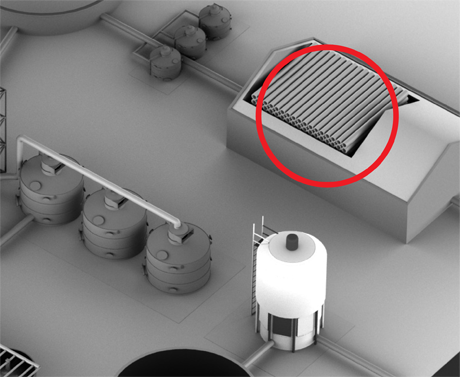
Reverse osmosis is a water purification technology that removes larger particles from drinking water.
The technology works by using a high pressure pump to increase the pressure on the salt side of a reverse osmosis membrane, forcing water through the membrane while almost all (approx. 95% to 99%) of dissolved salts remain behind in the reject steam. The more concentrated the feed water, the more pressure is required to overcome the osmotic pressure.
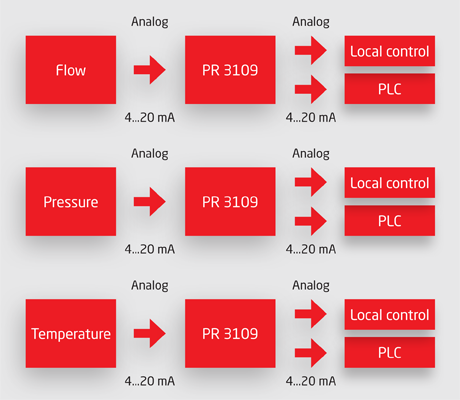
In a reverse osmosis system, measurements like flow, pressure, and temperature are necessary, and in this case, all are measured with two-wire transmitters. The output signals from these transmitters are connected to a local control panel and the main PLC.
The PR 3109 isolated converter / splitter is an excellent solution that powers the two-wire transmitters and provides high isolation between input and both outputs. This is a great replacement solution for older systems where one input is repeated using an extra analog output on the PLC. Our solution results in increased signal accuracy with super fast response time and the spare PLC analog output channels are now available for other tasks.
Application:
> Need more information? Please contact us.
What instrumentation does a reverse osmosis (RO) system require and how does PR Electronics support it?
Reverse osmosis systems require monitoring of feed pressure, permeate flow, reject flow, conductivity/TDS, temperature, and differential pressure across the membrane elements. PR Electronics signal conditioners provide galvanic isolation for these measurement signals, preventing ground loops between the RO skid instruments and the plant SCADA system. The PR 4116 Universal Transmitter handles diverse input types from pressure, flow, and temperature transmitters, while its relay outputs provide alarm contacts for critical parameters like high differential pressure (indicating membrane fouling) or low permeate quality.
Why is differential pressure monitoring important for reverse osmosis membrane performance?
Rising differential pressure across RO membrane elements indicates fouling, scaling, or biological growth that reduces permeate production and increases energy consumption. Monitoring DP trends across each membrane stage enables timely chemical cleaning (CIP) to restore performance before irreversible damage occurs. The PR 9116A Universal Converter provides accurate signal conditioning for DP transmitters with a relay output that can trigger a CIP alarm when the DP exceeds the cleaning threshold, helping operators maintain optimal membrane performance and extend membrane replacement intervals.
How does signal splitting benefit reverse osmosis plant monitoring?
RO plants must monitor permeate quality for both process control (adjusting operating pressure and recovery ratio) and regulatory compliance (meeting drinking water or discharge standards). The PR 3108 Isolated Splitter takes the conductivity or TDS analyzer signal and provides two electrically isolated outputs — one for the process PLC controlling the RO system and one for the independent quality monitoring/compliance system. This eliminates the need for duplicate analyzers while maintaining complete electrical independence between the control and compliance systems.