


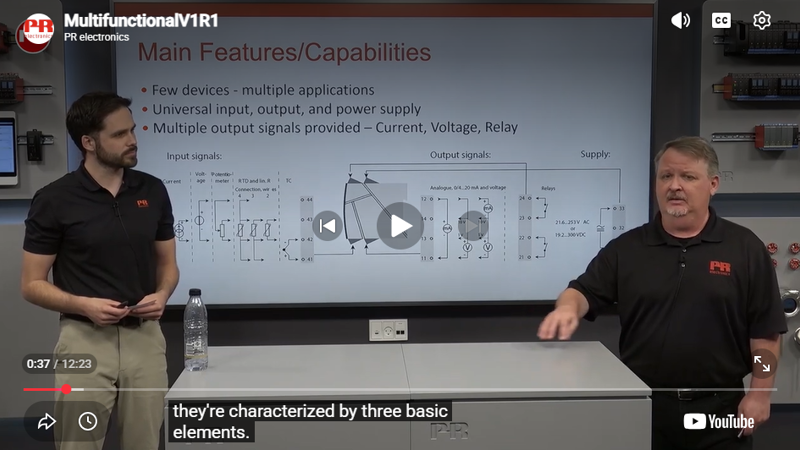
Multifunctional transmitters
Dive deeper into the benefits and applications of multifunctional transmitters in this Tech Talk.
Signal
Conditioning
Devices
NO
I want to send my request now
YES
I want to continue browsing before sending my request

Most process engineers have experienced it.
Two nearly identical skids are installed in the same facility. Both perform the same process function, but the signal interfaces, documentation standards and spare-part requirements are different.
When a fault occurs, maintenance teams spend valuable time identifying the installed hardware, finding the correct documentation and sourcing the right replacement parts.
This article explores the various hidden costs of not standardizing signal interfaces and how a standardized approach can simplify engineering, commissioning, and maintenance and thereby lower the lifecycle costs of an installation.
When different signal conditioners, barriers, isolators, and interface modules are used across projects, complexity quickly finds its way into daily engineering work.
This can include:
During engineering and design
More time spent selecting and validating products
Multiple documentation standards and design approaches
Increased engineering effort when updating or replicating designs
During commissioning
Additional time spent familiarizing teams with different products and configuration methods
More complex FAT and SAT procedures
Greater risk of inconsistencies between projects
During operation and maintenance
Slower fault-finding and troubleshooting
Higher dependency on individual experts
More training requirements for maintenance personnel
In spare-part management
Larger spare-part inventories
Increased purchasing complexity
Greater risk of component obsolescence
None of these costs appear on a component datasheet but together they contribute significantly to the total cost of ownership of a control cabinet throughout its lifecycle.
Standardization does not mean forcing the same device into every application. Signal requirements, hazardous-area classifications, SIL requirements and regional approvals must always be considered.
Instead, standardization is about establishing approved product families, design principles, documentation practices and test procedures, functioning as a common reference point across projects, cabinets, and facilities.
As the standard is adopted, benefits can include:
Faster engineering and design work
More consistent documentation
Easier knowledge transfer between teams
Reduced risk of configuration and installation errors
Simpler training of new engineers and technicians
Standardized architectures can also support the reuse of validated wiring diagrams, configuration templates and FAT/SAT procedures.
Rather than creating these elements from scratch for every project, engineering teams can build on proven designs and focus their efforts where customization adds value.

The benefits do not stop when the cabinet leaves the workshop.
For maintenance teams, the value of standardization often becomes most visible years after commissioning. Familiar products, consistent drawings and established testing procedures can make fault-finding significantly easier.
Where supported by the selected signal interface, technicians may also be able to simulate signals during testing and maintenance, helping to verify loops more efficiently and isolate faults faster.
A standardized architecture can help deliver:
Faster commissioning
Easier maintenance
More efficient troubleshooting
Fewer spare-part variants
Lower lifecycle costs
Simpler expansion of existing facilities
When new projects are launched, proven designs can often be reused rather than recreated. Maintenance teams know what to expect, and engineers can build on previous work instead of starting from scratch.

Instrumentation products are often selected based on technical specifications and purchase price. But a lower unit purchase price does not automatically mean a lower installed or lifetime cost.
The total cost of ownership typically includes:
Hardware purchase and installation
Engineering and design effort
Commissioning and testing time
Training requirements
Spare-part inventory
Maintenance effort
Downtime exposure
In many cases, these lifecycle costs can have a greater impact on the overall economics of a project than the purchase price of the interface hardware itself.
For that reason, one of the most important questions is not just whether a product can perform a required function, but whether it contributes to a consistent standard that reduces complexity across the entire lifecycle of an installation.
Achieving the benefits of standardization requires more than selecting components that meet a technical specification. It requires products that can be used consistently across applications, signal types, and installation environments.
This is where PR electronics' portfolio of signal conditioning devices can support a standardization strategy.
Many PR electronics devices are designed to cover multiple application requirements within the same product family. For example, many transmitters can handle several common signal types, while common configuration interfaces and engineering principles can simplify setup, maintenance and training activities across multiple installations.
This allows engineers to standardize on a smaller number of approved products while still meeting the requirements of different applications.
A useful starting point is to review your current signal-interface portfolio and identify where a smaller, approved set of standard solutions could simplify engineering, commissioning and maintenance activities.
Discuss the standardization opportunities within your plant, skid or cabinet designs with one of our sales engineers.