Filter press building
Noise isolation
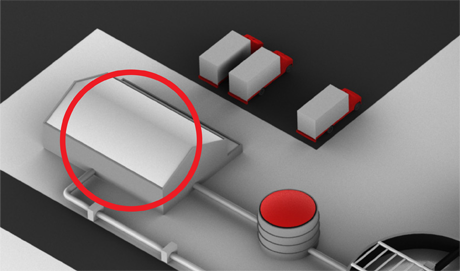
The filter press separates solids from the water by using the principle of pressure drive, provided by a slurry pump. The water is forced through the filters under pressure enabling the filter to catch solids while the water passes through. The filter press is a fixed volume and batch operation, which means that the process must be stopped to discharge the filter cake before the next batch can be started. As the filters are loading, system pressure increases due to the formation of thick sludge.
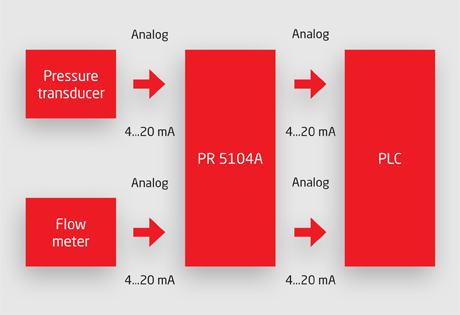
To optimize the process, control of the constant flow pumps is done through a PLC which requires input from a pressure transducer and a flow meter. Ultimately, the PLC controls a VFD (Variable Frequency Drive) on the pump motor.
Both the pressure transducer and the flow meter are two-wire styled units. Due to noise from the VFD, a robust, noise immune measurement system is needed. In this application one double channel 5104A repeater / power supply is used providing high 3.75 kV isolation and fast response time.
Application:
> Need more information? Please contact us.
What instrumentation is used in filter press wastewater treatment applications?
Filter presses dewater sludge by applying hydraulic pressure to force water through filter cloths, producing a solid cake for disposal. Key measurements include hydraulic pressure (to monitor press closure force and detect cloth blinding), filtrate flow (to track dewatering rate), and feed pump pressure. PR Electronics signal conditioners such as the PR 4116 Universal Transmitter isolate and convert these pressure and flow transmitter signals for the PLC, with relay alarm outputs for high-pressure shutdown protection.
How does signal conditioning support filter press automation in wastewater treatment?
Automated filter press operation requires reliable signal conditioning for the hydraulic pressure, feed pump control signals, and filtrate flow measurement that govern the press cycle (filling, pressing, membrane squeeze, cake discharge). The PR 4116 provides isolated analog output for the PLC with two relay contacts that can serve as high-pressure shutdown and cycle-complete indicators. The PR 3108 Isolated Splitter enables one pressure transmitter to feed both the process PLC and an independent safety shutdown system for overpressure protection.
What are the benefits of using PR Electronics isolators in a filter press building?
Filter press buildings contain high-power hydraulic pumps, air compressors, and conveyor motors that generate significant electromagnetic interference. Ground loops between the press structure and the PLC cabinet can introduce measurement errors in pressure and flow signals. PR Electronics isolators with greater than 60 dB signal-to-noise ratio and 2.3-2.6 kVAC galvanic isolation eliminate these noise sources, ensuring the PLC receives accurate process data. The compact 6.1 mm slimline housing of the PR 3103 allows high channel density in the limited panel space typical of filter press control rooms.