


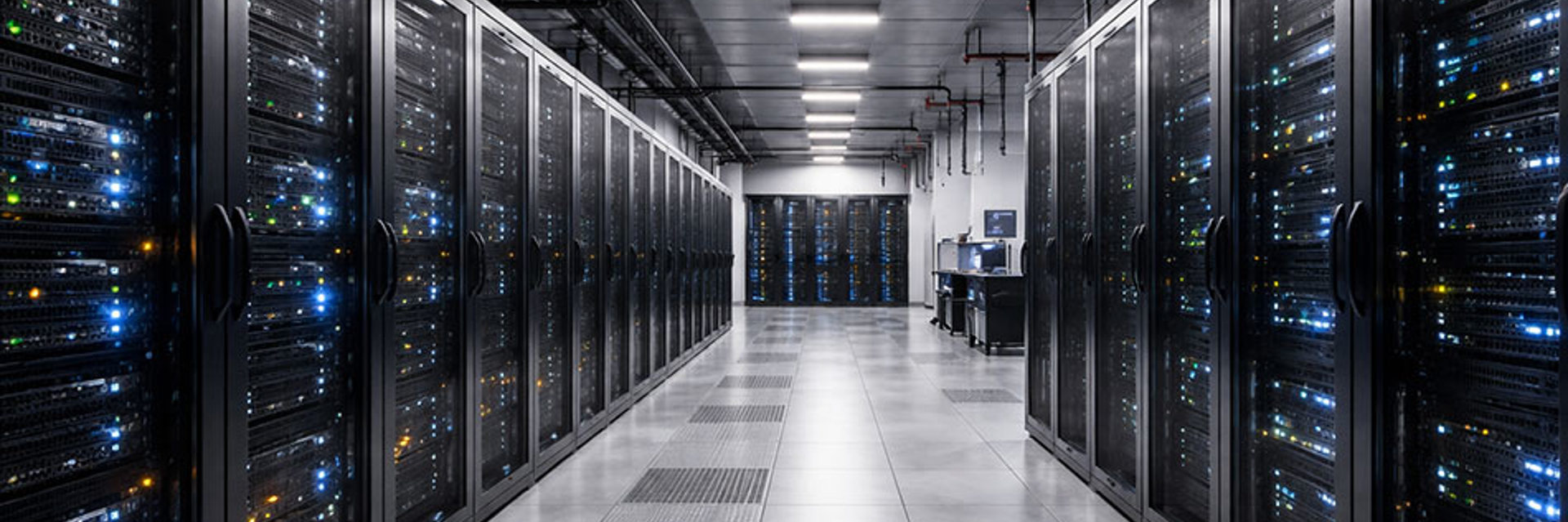
Evolution in control and automation for data centers
Modern life has an insatiable demand for data. From internet shopping to AI, from banking to gaming, we rely on instant access to vast amounts of digital data.
Data centers are a critical part of the infrastructure that supports this demand.
What is a data center?
A data center is a physical room, building or large facility housing the IT infrastructure dedicated to managing the storage of, and delivering, the digital services we interact with on a daily basis.
To ensure we can access this data reliably and consistently 24/7, it is important that these facilities are designed to operate continuously with minimum downtime.
Industry standards exist from organizations like the Uptime Institute to assist in the design, construction and maintenance of data center facilities.
The Uptime Institute defines data centers into four tiers based on various factors, as summarized below:
Tier 1
- Single power and cooling source.
- No redundancy.
- No fault tolerance.
- Maximum 28.8 hours of downtime per year.
Tier 2
- Single power and cooling source, but with additional fail-safes for backup, such as UPS modules, backup chillers, pumps and generators.
- No fault tolerance.
- Maximum 22 hours of downtime per year.
Tier 3
- Multiple power and cooling sources.
- Redundancy N+1.
- Partial fault tolerance.
- Maximum 1.6 hours of downtime per year.
Tier 4
- Multiple power and cooling sources with backup.
- Redundancy N2, N2+1.
- Fault tolerant.
- Maximum 0.4 hours of downtime per year.
How data center control systems evolve toward industrial automation
As data centers have evolved from small server rooms to large-scale facilities, the infrastructure required to keep them running has also evolved.
Whilst initially there may have been little or nothing in the way of climate control or power backup for small installations with modest computing power, this is no longer the case.
As computing power and the scale of facilities have grown exponentially, so has the need and complexity of climate control, power optimization and associated security.
This evolution is moving the control and automation of higher-tier facilities from a BMS-focused solution to a more hybrid/industrial automation architecture.
A traditional Building Management System (BMS) or Power Management System (PMS) system is unlikely to fully support the guaranteed uptime demand, necessary redundant architectures and asset optimization required for higher-tier data center operation.
Reliable controllers integrated with DCIM (data center integrated management) platforms supporting high system availability are needed to control not only the computing infrastructure but also ancillary equipment such as climate control, asset management and security.
These controllers also ensure seamless transition to redundant or backup systems in the event of a failure.
Role of PR electronics in data center automation
Devices from PR electronics can be used in various applications within data centers to ensure accurate and repeatable process values from critical measurement points.
Independent and diverse redundant systems are typically used to remove the possibility of systematic failures that can result in extended downtime and associated financial impact.
As such, in tandem with traditional BMS and associated management and control, proven industrial control and automation components can be used to meet the diversity and independence required in these scenarios.
Typical examples of where PR electronics devices can be used include:
AC airflow monitoring
Ensuring adequate airflow through the extensive HVAC systems used in data centers is critical to the efficient running of the IT infrastructure. The ambient temperature of server rooms must be maintained at a specified level, and airflow must be carefully regulated and monitored. This is primarily achieved via the BMS HVAC control system using airflow sensors.
To add the required independent and diverse redundancy, the PR 4116 Universal Converter can be used to ensure uninterrupted cooling.
The PR 4116 can be configured to transmit a 4-20 mA signal representing the airflow to the control system and to provide independent low-flow warnings or interrupted-flow alarms via two relay outputs.
Temperature monitoring
There are many temperature measurement points within a data center. From ambient air temperatures to individual rack and component temperatures, all must be closely monitored to ensure operational efficiency and to detect potential overheating or overload conditions that could result in failures or downtime.
Accuracy and fast response times are essential across all temperature measurement points.
The PR 5437 is particularly suited to rack applications. Racks typically have sensors measuring both intake and exhaust temperatures, with a target delta between these two values of < 20°C.
With true dual-input capability, the PR 5437 can accept inputs from both intake and exhaust sensors and transmit a 4–20 mA signal representing the difference between the two inputs. This allows for straightforward integration of the temperature differential into the control system.
Programmable sensor limits also mean that NE107-compliant warnings can be sent to the control system as early indications of potential issues, enabling preventive maintenance procedures to be initiated in good time.
Ancillary equipment monitoring and control
Backup and redundant power supply systems and ancillary equipment are important in assuring maximum uptime and resilience against unforeseen outages or equipment failure.
BESS (Battery Energy Storage Systems) are increasingly being used to store renewable energy. Large data centers will have dedicated BESS systems integrated into their power management strategy, often making use of wind or solar energy to supply the batteries. PR electronics equipment is used extensively in large BESS systems. Read more about BESS in our article here.
Additionally, equipment such as backup generators and cooling pumps is required to maintain uninterrupted operation. Whether these systems are skid-mounted or integrated, PR electronics devices are well proven for these applications.
The PR 4179 can be used to monitor voltage or current in power monitoring and balancing, ensuring regulated real-time control over the extensive power demands of a data center.
Reliable signal conditioning for the future of data centers
As data centers evolve to handle more data with increasing demand, PR electronics can be relied upon to deliver accurate and reliable signal conditioning now and in the future.
Contact us to discuss how our devices can support your data center architecture.