Naphtha hydrotreater
Temperature measurement
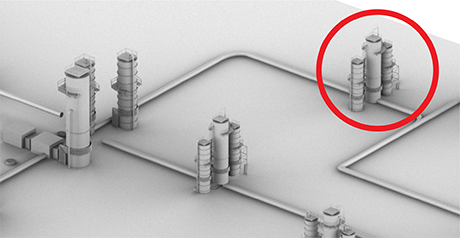
The naphtha cut from the atmospheric distillation unit is sent to the naphtha hydrotreater to remove sulfur and nitrogen compounds. The naphtha hydro treating unit uses a cobalt-molybdenum catalyst to remove sulfur by converting it to hydrogen sulfide that is removed along with unreacted hydrogen. Reactor conditions for a naphtha hydrotreater unit are around 400-500˚F (205-260˚C) with a pressure of 350-650 psi (25-45 bar).
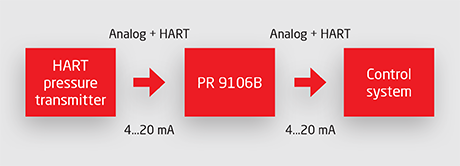
A two-wire style HART pressure transmitter is used to control the hydrotreater pressure. This application requires intrinsically safe signal measurement and SIL 2 with full assessment. The PR 9106B HART transparent repeater is connected to the pressure transmitter to bring the signal into the safe area. The output from the 9106B is connected to a control system and the HART information from the pressure transmitter passes through the 9106B for diagnostic purposes.
Application:
> Need more information? Please contact us.
Why is HART transparency important for naphtha hydrotreating unit instrumentation?
In a naphtha hydrotreating unit, temperature transmitters continuously monitor reactor bed temperatures to control the exothermic desulfurization reaction. HART transparent signal conditioning — as provided by the PR 9106B — allows operators to access smart transmitter diagnostics, calibration data, and configuration parameters from the control room without removing the I.S. barrier from the loop. This is critical for predictive maintenance because it enables early detection of sensor drift or degradation without requiring physical access to the hazardous reactor area.
How does the PR 9106B ensure reliable signal transfer from hazardous area temperature sensors in a hydrotreater?
The PR 9106B provides 2.6 kVAC galvanic isolation between the field sensor circuit in the hazardous area and the safe area DCS. It passes both the 4-20 mA analog signal and superimposed HART digital communication with accuracy better than 0.1% of span and response time under 5 ms. The integrated status relay provides independent alarm contact for sensor failure or line break detection, enabling rapid response to measurement faults in the critical hydrotreater temperature control loop.
What SIL rating is required for temperature measurement loops in naphtha hydrotreater applications?
Naphtha hydrotreater temperature measurement loops that serve as part of a Safety Instrumented Function (SIF) — such as high temperature shutdown protection — typically require SIL 2 per IEC 61511 and the facility's Safety Requirements Specification (SRS). The PR 9106B is SIL 2/3 fully assessed per IEC 61508:2010, with published FMEDA data for safe failure fraction (SFF) and hardware fault tolerance calculations. This enables instrumentation engineers to incorporate it directly into SIL verification calculations.