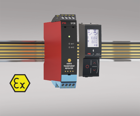
Fluid catalytic cracker
Differential pressure measurement
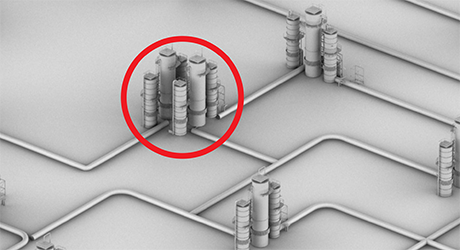
The fluid catalytic cracking unit is a process unit used to upgrade the heavier, higher-boiling fractions from the crude oil distillation by converting them into lighter, lower boiling, more valuable products.
One main challenge for a fluid catalytic cracking unit is to avoid a catalyst reversal in the reactor-regenerator section. As the impulse lines for this application tend to plug, it is crucial that the differential pressure measurement works properly and detects line plugging quickly in order to avoid catalyst reversal.
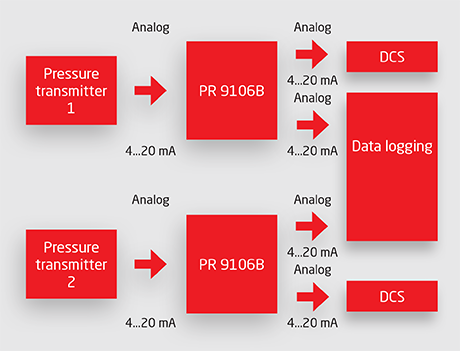
A redundant system with 2 differential pressure transmitters is required. Each transmitter is connected to the PR 9106B HART transparent repeater, the signal is split, one output is connected directly to the control system and the other is connected to an independent data logging system for documentation purposes. This solution detects line plugging and gives adequate time to act before a reversal of catalyst incident occurs.
Application:
> Need more information? Please contact us.
What is a cat cracker and why does it require differential pressure measurement?
A Fluid Catalytic Cracker (FCC), commonly called a cat cracker, is a critical refinery unit that converts heavy gas oil into lighter, more valuable products like gasoline and diesel using a zeolite catalyst. Differential pressure measurement across the reactor and regenerator monitors catalyst circulation rate, bed density, and cyclone performance. PR Electronics signal conditioners such as the PR 9116B Universal Converter ensure these DP measurements are accurately transmitted from the hazardous area to the DCS with full galvanic isolation.
How does signal conditioning improve differential pressure monitoring in an oil refinery cat cracker?
Cat cracker DP transmitters operate in extremely harsh conditions with temperatures exceeding 1000 degF (538 degC) in the regenerator and fluidized catalyst creating high vibration and electrical noise. Signal conditioners like the PR 9106B isolate the DP transmitter signals from ground loops and electromagnetic interference generated by nearby high-power equipment such as air blowers and compressors. The 2.6 kVAC galvanic isolation and greater than 60 dB signal-to-noise ratio ensure the DCS receives clean, accurate pressure differential data.
What safety instrumentation considerations apply to a fluid catalytic cracker?
FCC units are among the most safety-critical process units in a refinery due to extreme temperatures, fluidized catalyst hazards, and large hydrocarbon inventories. Pressure, temperature, and level instrumentation loops feeding safety instrumented functions (SIFs) must use SIL-rated signal conditioning. PR Electronics 9000-series devices carry SIL 2/3 full assessment per IEC 61508, with FMEDA reports available for safety lifecycle calculations. This ensures that the I.S. barrier or converter does not become the weak link in the safety loop.